



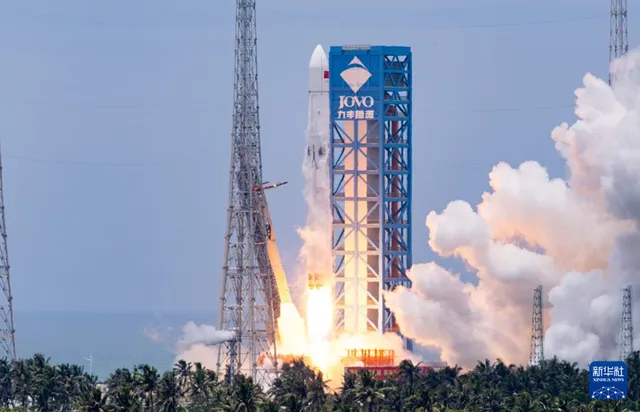
China reached this milestone by combining several key technologies into a single mission. After the Long March 10B rocket delivered its payload into orbit, its first stage did not fall into the ocean like a traditional expendable rocket. Instead, it performed a controlled return to Earth.
During the descent, the booster reignited its engines to slow down while grid fins continuously adjusted its flight path toward a recovery ship waiting offshore. Unlike SpaceX’s Falcon 9, which lands on deployable landing legs, China’s rocket used a different approach. The first stage descended into a giant net installed on the recovery vessel Navigator. Hooks on the rocket engaged with the net, while a shock absorption system reduced the impact and secured the booster safely.
The successful recovery was the result of years of testing. Chinese engineers had already carried out multiple engine firing tests, low altitude flight demonstrations and return control experiments before attempting a full orbital recovery. The July 10 mission became the first to complete the entire sequence of launch, orbital insertion and controlled first stage recovery.
The achievement does not mean China has caught up with SpaceX, which has spent nearly a decade refining reusable rocket technology and routinely reuses Falcon 9 boosters. However, it marks China’s first successful demonstration of a complete reusable launch process and introduces a different recovery concept that could reduce rocket weight, increase payload capacity and support future missions such as large satellite constellations and crewed lunar exploration.