China’s artificial intelligence infrastructure is not concentrated in a single location but spread across a growing nationwide network of computing hubs, with some of its largest data center clusters increasingly located in the country’s energy-rich western and northern regions.
The expansion is part of Beijing’s “East Data, West Computing” strategy, a national project designed to move computing-intensive workloads from densely populated technology centers in eastern China toward regions where land, electricity and renewable energy are more abundant.
China has established eight national computing hubs and 10 major data center clusters, according to the National Development and Reform Commission (NDRC). The eight hubs cover the Beijing-Tianjin-Hebei region, the Yangtze River Delta, the Guangdong-Hong Kong-Macao Greater Bay Area, the Chengdu-Chongqing economic circle, Inner Mongolia, Guizhou, Gansu and Ningxia.
The 10 designated clusters provide a more precise picture of where much of China’s large-scale computing infrastructure is being developed.
They are Zhangjiakou in Hebei; Horinger in Inner Mongolia; Zhongwei in Ningxia; Qingyang in Gansu; Gui’an in Guizhou; Wuhu in Anhui; the Yangtze River Delta Ecological and Green Integrated Development Demonstration Zone; Shaoguan in Guangdong; Tianfu in Sichuan; and Chongqing.
These national clusters do not represent all of China’s AI data centers. Technology companies, telecom operators, cloud providers and local governments operate additional computing facilities across the country, including around major technology centers such as Beijing, Shanghai, Shenzhen and Hangzhou.
Why is China moving AI computing west?
The geography reflects one of the biggest problems facing the AI industry: electricity.
Training and running large AI models requires enormous amounts of computing power and therefore large supplies of electricity. China’s eastern cities contain many of the country’s technology companies and users, but land and energy are relatively expensive.
Western and northern China, by contrast, offer more space and access to large supplies of wind, solar and other energy resources.
The strategy is therefore relatively straightforward: keep latency-sensitive computing closer to major eastern economic centers while shifting suitable workloads, including some AI training and batch inference, toward large western computing facilities.
This shift is already visible.
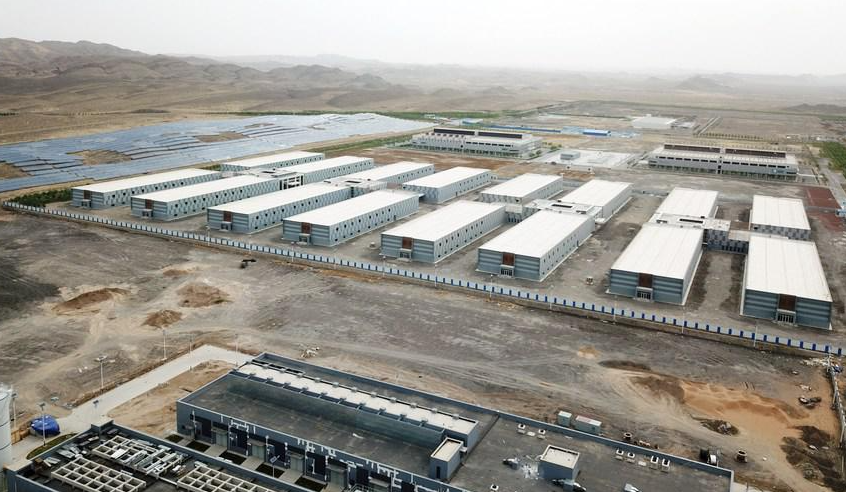
In Horinger New Area near Hohhot, Inner Mongolia, more than 30 data centers were under construction within a radius of just three kilometers in 2026.
In Zhongwei, Ningxia, new facilities are being specifically designed for AI servers, requiring much denser optical-fiber connections and larger server rooms than conventional data centers.
Qingyang in Gansu has also emerged as a major AI computing center. China planned 22 additional data center buildings there in 2026, with local computing capacity expected to exceed 200,000 PFLOPS by the end of the year.
China is building a distributed AI infrastructure
The result is an AI computing network that increasingly resembles a geographically distributed utility rather than a handful of isolated supercomputers.
By the end of 2025, China had built 145 backbone fiber-optic routes around its national computing hubs. Authorities said network latency between the eight hubs, and from provinces to those hubs, had been reduced to below 20 milliseconds.
By March 2026, China’s intelligent computing capacity had reached 1.882 million P, about 2.5 times the level recorded a year earlier, according to the NDRC. More than 80 percent was concentrated around the eight national computing hubs.
That distribution is important for understanding China’s AI ambitions.
Beijing, Shanghai, Shenzhen and Hangzhou remain major centers for AI research, model development and technology companies. But an increasing share of the physical infrastructure supplying the computing power behind those models is being built hundreds or even thousands of kilometers away.
China is effectively separating where AI is developed from where much of the computing is performed.
Data and computing tasks can travel through high-speed fiber networks to enormous server facilities in places such as Inner Mongolia, Ningxia, Gansu and Guizhou, where electricity and land are easier to obtain.
As AI models require increasingly large amounts of computing power, this distributed architecture could become an important strategic advantage. Instead of relying on a small number of data center locations, China is building an interconnected national computing network spanning multiple provinces and energy regions.
So where are China’s AI data centers?
The short answer is: across the country, but increasingly concentrated in a network stretching from China’s eastern technology centers to huge computing clusters in its western and northern provinces.
The servers powering China’s AI boom may serve companies in Beijing, Shanghai or Shenzhen, but a growing share of the electricity, racks and computing capacity behind them can be located far away in Inner Mongolia, Ningxia, Gansu or Guizhou.
AI-assisted translation