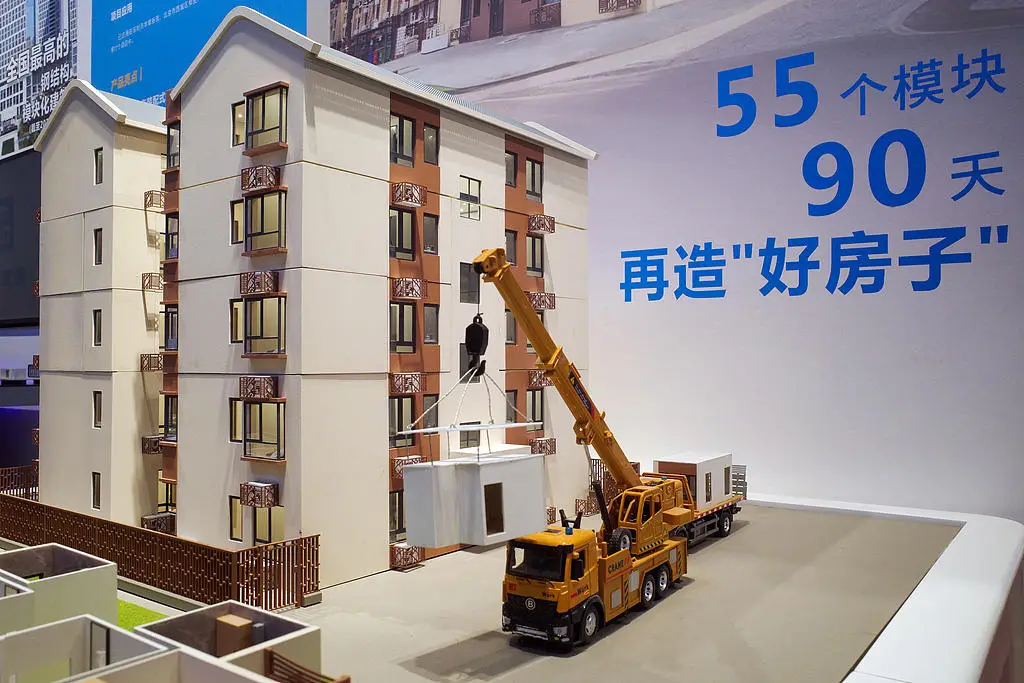
China’s prefabricated modular homes are rapidly gaining popularity worldwide because they can reduce construction time by more than 60%, cut labor costs, and allow developers to start generating revenue much sooner. Here’s why builders from the UK to Papua New Guinea are increasingly choosing modular buildings made in China.
Instead of constructing an entire building from the ground up at the job site, Chinese manufacturers divide it into large factory-built modules. Each module is produced in a controlled manufacturing environment and can already include walls, floors, plumbing, electrical systems, windows, and even basic interior finishes. The completed modules are then shipped overseas and assembled on site like giant building blocks.
By the time these modules arrive at their destination, more than 90% of the construction work has already been completed. Workers only need to connect the modules and finish common areas, leaving less than 10% of the work to be done on site. This dramatically reduces construction time.
Speed is one of the biggest selling points. According to Chinese builders, modular construction can shorten project timelines by more than 60% compared with conventional methods. For example, a hospital that would normally take three years to build can be completed in just one year and eight months using modular technology.
This advantage is especially attractive in countries where labor costs are high. A British property developer explained that after comparing suppliers from several countries, the company ultimately chose China because no competitor could match its overall price and value. In one retirement housing project, 63 modules were shipped from China to Southampton and assembled on site in just two weeks.
The same model has proven successful elsewhere. In Papua New Guinea, 84 modules were transported by sea from China and assembled into fully functional hotels. After the first phase was completed successfully, the developer continued placing new orders because the approach significantly reduced labor costs while allowing the project to generate revenue much sooner.
Another major advantage is industrial-scale manufacturing. Unlike traditional construction, which depends heavily on weather conditions and manual labor, modular buildings are produced on automated production lines similar to those used in the automotive industry. Robotic welding, intelligent warehouses, and digital manufacturing systems ensure consistent quality while enabling factories to produce 20,000 to 30,000 modules annually.
Modular buildings are also highly versatile. They can be used for hotels, apartments, student housing, offices, hospitals, schools, and even data centers. In hospitals, individual modules can be removed for maintenance and reinstalled later, or even relocated entirely in response to public health emergencies.
China’s success also comes from its highly integrated supply chain. The country controls nearly every stage of the process, including design, steel production, module manufacturing, factory automation, international shipping, and overseas installation. This end-to-end capability helps lower costs, improve efficiency, and deliver projects faster than many competitors.
As a result, exports of Chinese prefabricated buildings have grown rapidly. According to data cited from China’s General Administration of Customs, the country’s exports of prefabricated buildings nearly doubled between 2015 and 2025, while exports in the first quarter of 2026 increased by approximately 45% year over year. Today, Chinese modular buildings are exported to more than 150 countries and regions.
China’s modular homes are becoming increasingly popular because they offer a compelling combination of speed, affordability, quality, and scalability. For developers and investors, completing a hotel, hospital, or apartment complex months or even years earlier means faster returns on investment and lower financial risk, making modular construction an increasingly attractive solution worldwide.
FAQ
What is a modular home?
A modular home is a building made from factory-built modules that are transported to the construction site and assembled there.
Why are Chinese modular homes cheaper?
China benefits from a complete manufacturing supply chain, lower production costs, and highly automated factories.
How long does it take to build a modular building?
Depending on the project, modular construction can reduce completion time by more than 60% compared with traditional methods.