





Vietnam’s Ministry of Health has drawn public attention after seeking opinions from children aged 7 and older on a draft amendment to the Law on Donation, Retrieval and Transplantation of Human Tissues and Organs and Donation and Retrieval of Human Bodies. The move has sparked debate on social media, with many questioning whether children this young can understand such a complex issue and whether their answers could be influenced by adults.
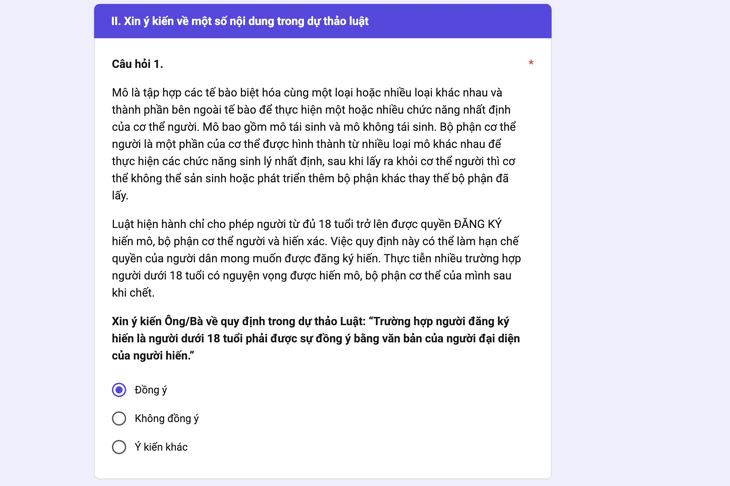
According to information provided by a representative of the drafting body to Tuoi Tre newspaper on October 22, the consultation is intended to ensure that children’s views are considered when developing policies and legislation that affect them. However, the agency stressed that it is not surveying every child aged 7 and above.
What are children being asked?
The questionnaire for children aged 7 to under 18 contains nine questions concerning provisions in the draft law. These focus on issues directly affecting minors, including registration to donate organs with the consent of a legal representative; donation of tissues or organs to family members by those aged 15 to under 18; and donation of tissues by children under 15 to treat their parents or biological siblings.
The agency conducting the survey said the questionnaire includes explanations of the terms used to help participants understand the issues. It has also asked healthcare facilities and selected educational institutions to help carry out the consultation.
At healthcare facilities, the children surveyed are mainly the children of staff members, patients and patients’ relatives, particularly those who already have some understanding of the subject or can receive an explanation. At educational institutions, the survey is being conducted among lower and upper secondary school students and university students, but not primary school pupils.
Children must receive appropriate guidance before participating and should not be expected to complete the questionnaire independently if they do not understand its content. Family members, healthcare workers and communications staff may explain the relevant issues to help them respond. In addition to predefined answer choices, the questionnaire allows children to express their own thoughts and opinions.
The debate goes beyond age
Concerns raised on social media focus on whether children can properly understand organ and tissue donation and transplantation, as well as the implications of the proposed legal provisions. Some have also questioned whether the answers genuinely reflect children’s own views or are influenced by parents, teachers or the wording of the survey questions.
An important distinction is that consulting children during the policymaking process does not mean giving them the authority to make independent decisions about organ donation. The survey is intended to gather opinions for consideration by lawmakers, while the legal conditions and requirements governing tissue and organ donation must still be specifically established by law.
According to the agency’s representative, the survey results will be reviewed and considered as the draft law is finalized and related implementing regulations are developed. The agency has not set a specific target for the number of responses, describing the exercise as a broad public consultation.
The central question, therefore, is not simply how old children should be to participate in a survey. It is also how the issues are explained to them, whether participation is genuinely voluntary, and how their views will be used in shaping the final policy.