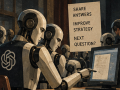
Debates about the harms of AI on students have long remained at the level of vague warnings. But from 2024 onward, scientific research has begun delivering concrete numbers, and they are far more alarming than most people realize.
A Brain Going Into Debt Without Knowing It
The most compelling evidence comes from MIT Media Lab’s study “Your Brain on ChatGPT,” published in June 2025. Researchers monitored 54 participants over four months, measuring brain activity via electroencephalography (EEG) during essay-writing tasks. The results showed that the group using ChatGPT had neural connectivity levels 55% lower than those who wrote entirely on their own. More strikingly, 83% of participants in the AI group could not quote from the essay they had just completed minutes earlier. When asked to write without any tools in the fourth session, this group showed even weaker neural connectivity than those who had never used AI at all, and 78% could not recall a single passage from their own work.
The researchers coined the term “cognitive debt” to describe this phenomenon: AI reduces immediate effort but accumulates long-term cognitive costs, including diminished critical thinking, reduced creativity and independent thought, and increasingly shallow information processing. This marks the first time AI’s harms have been measured through actual brain signals rather than self-reported surveys or subjective impressions.
Students Know, Yet Continue Anyway
A RAND survey of 1,214 American students from middle school through college, published in December 2025, reveals a telling paradox. The share of students using AI for homework climbed from 48% to 62% in just seven months. At the same time, 67% agreed that the more students use AI for schoolwork, the more it harms their critical thinking, a figure that rose more than 10 percentage points over the same period. In other words, the majority of students are simultaneously using AI, acknowledging its harms, and finding themselves unable to stop – a pattern that closely resembles the behavioral profile of addiction.
When AI Gets It Wrong, the Damage Outweighs the Benefit
A less-discussed risk is the impact of AI misinformation on learners who lack a solid knowledge base. A controlled trial involving 111 medical students, published in Nature in early 2026, produced a striking finding: misleading AI explanations significantly degraded diagnostic accuracy, while correct AI explanations offered no meaningful improvement over a control group that used no AI at all. The harm caused by wrong information was demonstrably stronger and clearer than any benefit from correct information.
This is especially concerning given that AI-generated misinformation is far from rare, with error rates ranging from 5% for general queries to 29% for specialized professional questions, and subtle errors such as slightly incorrect figures or fabricated-but-plausible citations are extremely difficult to detect. In February 2025, Google’s AI Overview confidently presented an April Fool’s satire about “microscopic bees powering computers” as factual in search results. If a system built by the world’s leading technology company makes errors like that, students in secondary school have little chance of catching them.
Students Are Asking AI About Mental Health, Friendships, and Family
A finding that receives far too little attention comes from a Center for Democracy and Technology (CDT) survey: students are not using AI only for academic work. As many as 29% have turned to AI to deal with anxiety and mental health concerns, 22% have used it to navigate conflicts with friends, and 16% have used it for family issues. In domains as sensitive and complex as these, a single piece of wrong advice from AI does not merely leave a factual misconception — it can cause real and lasting psychological harm.
Bias Hidden Inside Every Answer
Beyond random errors, AI carries systematic bias embedded in its training data. An analysis of more than 5,000 images generated by the AI tool Stable Diffusion found that it simultaneously amplifies both gender and racial stereotypes. What makes this more dangerous is that the perceived objectivity of technology makes users less willing to question biased outputs than they would be if those same ideas came from a human source. For students in the critical period of forming their worldview, repeated exposure to bias wrapped in confident, fluent language is the most quietly damaging risk of all.
None of the research cited above calls for banning AI. But all of it makes one thing clear: when students use AI to replace thinking rather than support it, the brain is damaged in ways measurable by electrical signals, cognition is distorted in ways not easily corrected, and dependency forms through the same mechanisms as addiction. These are no longer theoretical warnings. They are empirical findings, and we are racing against time to respond.